
Why Might Your Dentist Check Your Blood Pressure?
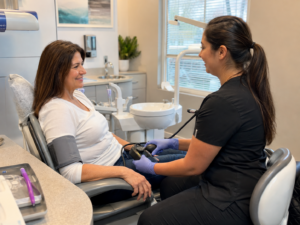
You may expect a dental appointment to include an examination, professional cleaning, and questions about your oral health. What may be less expected is having a blood-pressure cuff placed around your arm before treatment begins.
Blood-pressure screening can provide useful information because your current health status may be relevant to dental treatment planning. An unexpectedly elevated reading may also be worth repeating or discussing with a medical professional.
At Dr. Richard Lachenmayr’s office, complimentary blood-pressure checks are part of a broader preventive approach that also includes oral cancer screenings and routine dental care.
A blood-pressure check at the dentist does not diagnose hypertension. Instead, it provides another piece of health information that the dental team can consider alongside your medical history, medications, symptoms, and planned treatment.
Blood Pressure Is Part of Your Current Health Picture
Dentists need more information than what they can see in your mouth. Medical conditions, medications, allergies, previous procedures, and recent changes in your health may all be relevant when planning dental care.
Blood pressure can add useful information to that picture. Because elevated blood pressure does not always cause obvious symptoms, a person may have an unexpectedly high reading without realizing it.
Dental visits can therefore provide another opportunity for blood-pressure screening, including for some patients who may not have had a recent medical visit. That does not mean your dentist is taking over the role of a physician. The purpose is to gather relevant information and recognize when a reading may deserve additional attention.
Why Can Blood Pressure Matter Before Dental Treatment?
Your dental team may want to know your blood pressure because treatment planning considers more than the procedure itself.
For example, your dentist may review whether you have a history of high blood pressure, which medications you take, whether those medications have recently changed, how you are feeling that day, and what dental care is planned.
A blood-pressure reading is not considered in isolation. It becomes one part of the broader health history that helps the dental team understand your current situation.
This is one reason keeping your medical and medication information up to date matters at dental visits, even when your oral-health concerns have not changed.
Can Dental Anxiety or Pain Affect Blood Pressure?
Some patients are surprised when their blood pressure is higher at the dentist than it usually is at home or during another appointment.
Temporary changes can happen for several reasons. Stress, anxiety, dental pain, recent physical activity, and the circumstances surrounding the appointment can all influence a measurement.
That is why one unexpectedly high number should not automatically be interpreted as a diagnosis.
If the first measurement is higher than expected, the dental team may allow you to sit quietly and repeat it. Blood-pressure measurement guidance generally favors taking more than one reading rather than relying on a single measurement when the result is unexpected.
Repeated readings provide more useful context than immediately drawing conclusions from the first number recorded.
One High Reading Does Not Automatically Mean You Have Hypertension
Seeing a high number on a blood-pressure monitor can understandably be concerning, but one measurement at a dental appointment is not enough by itself to establish that you have hypertension.
Blood pressure naturally changes throughout the day. Some people also experience higher readings in healthcare settings than they do at home, sometimes called a white-coat effect.
If an unexpectedly elevated reading persists, your dental team may recommend follow-up with your primary care physician or another appropriate medical professional. That recommendation does not necessarily mean something is seriously wrong. It means the reading deserves confirmation and evaluation in the appropriate medical setting.
The dental team’s role is to screen and communicate, not to diagnose or manage hypertension.
What Happens If Your Blood Pressure Is Higher Than Expected?
If your reading is higher than expected, the dental team can look at the result in context instead of assuming there is an immediate problem.
They may repeat the measurement after you have had time to rest, review whether you have a history of hypertension, ask about blood-pressure medications, and discuss whether you are experiencing pain, unusual anxiety, or concerning symptoms.
If the reading remains elevated, medical follow-up may be recommended. The appropriate next step depends on the measurement, your health history, symptoms, medications, and the dental care being planned.
A blood-pressure check is therefore a screening step rather than a final medical conclusion.
Can High Blood Pressure Change Your Dental Appointment?
Sometimes it can, but the decision is more individualized than simply comparing the reading with one universal number.
Your dentist may consider the blood-pressure measurement together with your medical history, symptoms, medications, and the type of treatment planned. In some circumstances, the dental team may repeat the measurement, modify the treatment plan, communicate with your physician, or postpone elective care until additional medical information is available.
In other circumstances, treatment may proceed as planned.
The important point is that a single blood-pressure number should not be treated as an automatic rule that applies identically to every patient and every dental procedure.
If a reading is severely elevated and is accompanied by concerning symptoms, more urgent medical evaluation may be appropriate. Those decisions should be based on the overall clinical situation rather than self-diagnosis from a number alone.
Tell Your Dentist About Blood Pressure Medications
If you take medication for high blood pressure, include it on your current medication list and tell the dental team if anything has recently changed.
Medications can be relevant to dental treatment planning, and some blood-pressure medications may also have oral-health effects such as dry mouth or changes involving the gums.
An accurate medication list is also useful when your dentist is considering medications or local anesthetics that may be used during treatment.
Do not stop, skip, or change a prescribed blood-pressure medication because of an upcoming dental procedure unless the healthcare professional managing that medication specifically advises you to do so.
If you are unsure of the medication name or dosage, bringing an updated list or keeping the information on your phone can make it easier to provide accurate information during your appointment.
Blood Pressure Screening Is One Part of Preventive Dental Care
Dental visits naturally focus on your teeth, gums, and oral health, but responsible treatment planning also considers relevant information about your overall health.
A blood-pressure check can provide another useful piece of that picture. It may show a reading within an expected range, identify a number worth repeating, or occasionally prompt a recommendation for medical follow-up.
Dr. Richard Lachenmayr’s office includes complimentary blood-pressure checks as part of its broader preventive approach. The practice also provides routine dental care and other preventive services designed to help patients stay informed about their oral health.
The important distinction is that screening is not diagnosis. Your dentist can identify an elevated reading, consider how it may affect the planned dental visit, and recommend appropriate medical follow-up when needed. A physician or other qualified medical professional is responsible for determining whether you have hypertension and how it should be managed.
If you are due for a dental visit, schedule an appointment with Dr. Richard Lachenmayr’s office. Keeping your dental team informed about your current health, medications, and recent medical changes can help support personalized treatment planning.